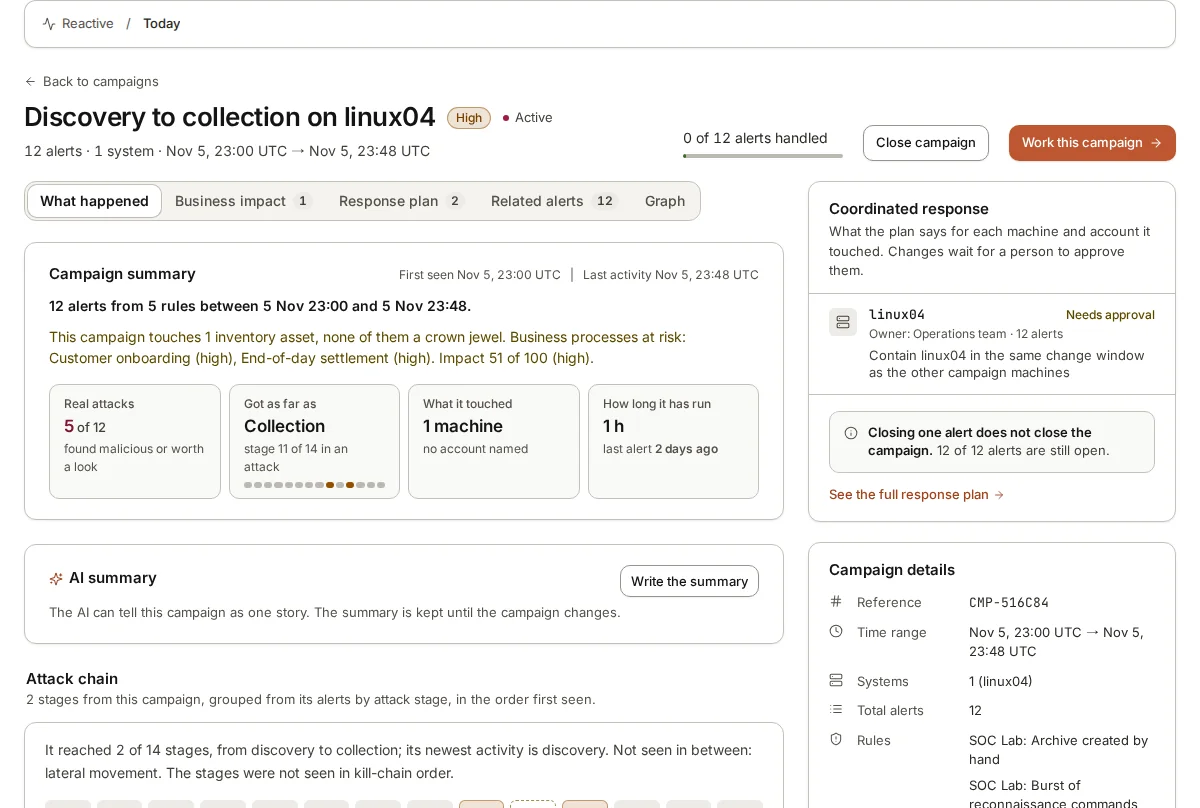
The whole attack on one page
How far it got, stage by stage, which machines and accounts it touched and how long it has been running. In our lab, twelve alerts from five rules were joined into one attack that ran from discovery to collection.
Campaigns
Alerts that belong to the same attack are joined into one campaign, so your team works the attack once instead of chasing its pieces one alert at a time.
An attacker who gets in will look around, collect what they find and try to stay. Each step can set off a different rule.
Twelve alerts from five rules look like twelve problems, until someone sees they are one.
Different people pick up alerts from the same attack and repeat each other’s searches.
Without the stages in order, it is hard to say whether the attacker is still looking around or already taking data.
Separate fixes for separate alerts can miss a machine, or undo each other.
Alerts from the same attack are joined and set out in time and by stage, so the story reads from first step to latest.
12 alerts from 5 rules → 1 campaign, discovery to collection
How far it got, stage by stage, which machines and accounts it touched and how long it has been running. In our lab, twelve alerts from five rules were joined into one attack that ran from discovery to collection.
The attack chain sets the alerts out in time and by MITRE ATT&CK stage, so you can read the attack from its first step to its latest.
Which business processes and important systems a campaign touches, from what you told armor360 about your company when you set it up.
A coordinated plan says what each affected machine and account needs. Every step waits for a person to approve it, and your team carries it out with its own tools.
Two or more alerts name the same machine, account or address within about two hours of each other, even when different rules raised them.
armor360 joins them into one campaign. Each alert stays linked to its own investigation, so the reasoning behind each piece can still be opened and checked.
The campaign shows the MITRE ATT&CK stages from first to latest, the machines and accounts touched, how long it has run and which business processes are at risk.
One coordinated plan says what each affected machine and account needs. Each step waits for a person to approve it, and your team carries it out.
Alerts that name the same machine, account or address close together in time are joined without anyone tagging them.
Each alert is placed on its MITRE ATT&CK stage, from discovery to collection and beyond.
The Today page flags attacks that may still be running, so they are checked first.
Machines, accounts and business processes in one list.
The campaign keeps the investigations, verdicts and decisions together for later review.
Nothing in the plan happens until a person says so.
It looks at what the alerts share. Alerts from your tools that name the same machine, account or address within a couple of hours of each other are joined into one campaign, and each one stays linked to its own investigation so you can check the reasoning.
Yes. A campaign lists every machine and account it touched. The plan then says what each one needs, and every step waits for a person to approve it.
No. The plan is a recommendation. Your team approves each step and carries it out with its own tools. armor360 keeps the record of who approved what and when.
Start a free pilot on your own alerts, or put in your own numbers first.