Skip to content

For regulated organisations

Your data, your model, your audit trail.

Run armor360 inside your own environment, the AI included, so alert data can stay within your organisation’s boundaries. Every verdict shows its evidence, and every approval is on record.

Inside your network0 alert records sent outYour networkElasticSplunkSentinelarmor360 and our modelYour teamdecidesOutside your networkCloud fallback: off
Illustrated example: run on-premises, the platform and our model sit inside your network, with the cloud fallback switched off.

AI is welcome, data leaving is not.

Banks, insurers, health providers and public bodies want help with their alert queue, but not at the price of sending security data outside.

  • Security data is sensitive

    Alerts carry user names, machine names, internal addresses and fragments of what people were doing. Sending them to an outside AI service raises questions your data protection officer will rightly ask.

  • Auditors want the working

    A verdict on its own is not enough. Auditors and regulators ask why an alert was closed, who decided and on what evidence. An answer of "the AI said so" will not pass.

  • Automation that acts is a risk

    A tool that changes machines or accounts on its own can disrupt a payment run or a clinical system. Many organisations need every change made by a named person, with approval recorded.

  • Change needs control

    Switching off a detection rule or changing a setting can open a gap nobody notices. Those changes need more than one pair of eyes and a record that shows who agreed.

Where the data goes, drawn.

Platform and model inside your boundary, fallback off, people deciding.

Where your alert data goesIllustrated example
Your networkYour SIEMAlerts and eventsarmor360Investigationsarmor360 AIOn your GPUYour peopleReview and decideFallback off
Run fully on-premises, the platform and its AI model sit inside your network. With external AI fallback switched off, investigations run without alert data leaving it.

Data stays where you decide

armor360 runs on its own AI model, fine-tuned by our team, and it can run fully on-premises on your own hardware. With external AI fallback switched off, investigations run without alert data leaving your environment. If you would rather not run it yourself, it can be hosted for you instead.

  • Fully on-premises, the AI included
  • External AI fallback can be switched off
  • Or hosted for you, if you prefer

Evidence an auditor can follow

Every record the agent collected is kept and cited where it is used. Each verdict links back to the event, lookup or log line behind it, so anyone reviewing a closed alert can see what was checked, what was found and why the agent reached its conclusion.

The path to the verdict, drawn out

The investigation map shows the alert, the machine and accounts involved, the data sources read, each question the agent asked, the verdict and the recommended next steps. The path that backs the verdict is drawn in red, so a reviewer can trace the reasoning at a glance.

No action without a person

armor360 does not change your machines, accounts or network. It detects, investigates and tells a person. When an attack needs a plan, every step waits for someone to approve it. Who approved what, and when, is kept in the audit trail.

Changes stay controlled

A detection rule goes live only when a person approves it, and switching a rule off needs two administrators to agree. Sign-in works through Okta, Microsoft Entra ID or any OIDC provider, or a password with a second step, and armor360 asks you to confirm again before sensitive changes.
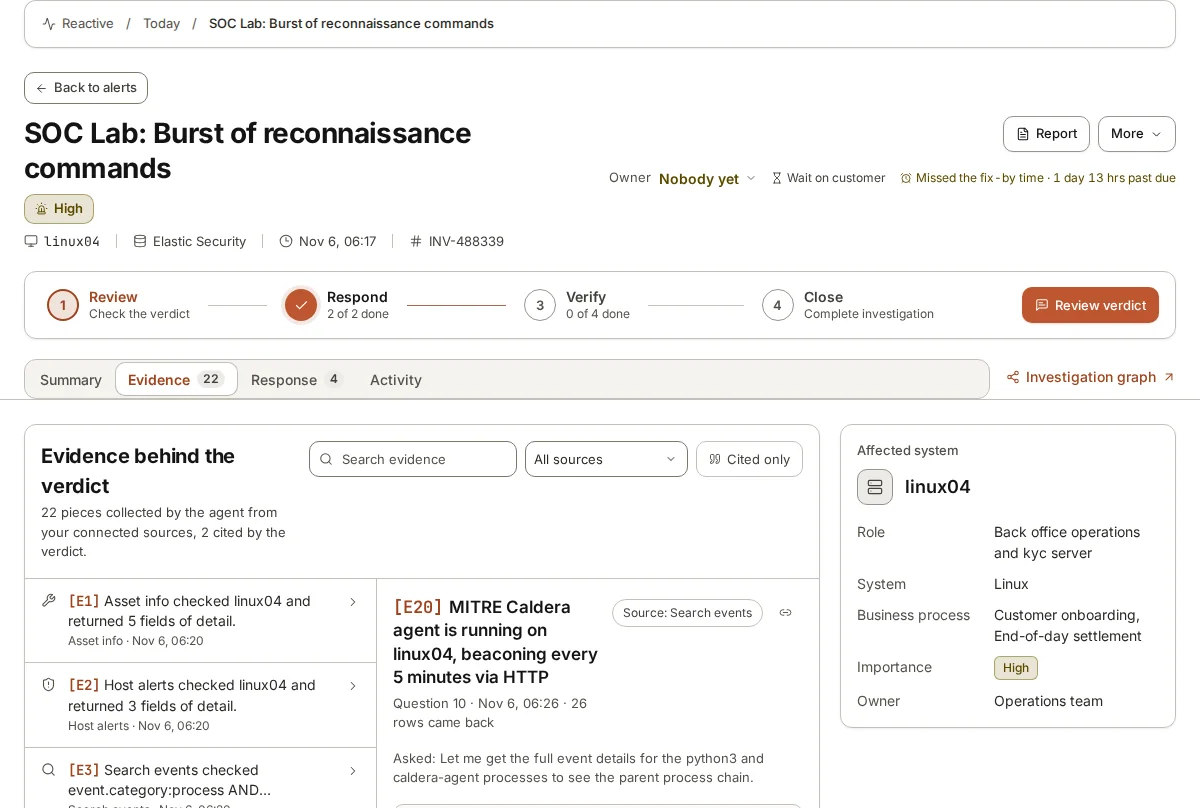
How it works in a regulated organisation.

  1. 1

    Install inside your boundary

    armor360 and its own model run on your hardware, inside your network. With external AI fallback switched off, investigations stay within your environment.

  2. 2

    Investigate with a record

    The agent investigates each alert and keeps each record it reads, numbered and cited where it is used, with the path to the verdict drawn on the map.

  3. 3

    A named person decides

    A reviewer agrees with the verdict or changes it. Plan steps wait for approval, and armor360 makes no change to your machines, accounts or network.

  4. 4

    Show the auditor

    Who approved what, and when, is kept in the audit trail, along with rule approvals and the two administrators needed to switch a rule off.

Controls a regulated organisation expects.

  • On-premises AI

    Our own model, fine-tuned by our team, running on your hardware inside your environment, with external AI fallback switched off if you choose.

  • Audit trail

    Who approved what and when, kept for every verdict change, detection rule and plan step, ready for review.

  • Cited evidence

    Each verdict links to the records behind it, so a closed alert can be explained later.

  • Two administrators to switch off

    Turning a detection rule off needs two administrators to agree, so a gap in detection is never opened quietly by one person.

  • Single sign-on

    Okta, Microsoft Entra ID or any OIDC provider, or a password with a second step.

  • Reports for reviewers

    Investigations shared as HTML, Word or PDF reports, written for the people who receive them.

Handling an alert under audit, by hand and with armor360.

TopicBy hand todayWith armor360
Where data goesUsing an outside AI service means new data processing agreements, risk assessments and questions from the data protection officer. The model runs on your hardware with fallback switched off, so alert data need not leave your environment.
Explaining a closeMonths later, the reason an alert was closed is often a one-line note that nobody can expand on. Each closed alert keeps its verdict, its reason and its cited records, so the decision can be explained later.
Who decidedApprovals happen in chat or by phone, and the record of who agreed is scattered or missing. The audit trail keeps who approved each verdict change, rule and plan step, and when.
Rule changesOne administrator can switch a rule off quietly, and the gap may only come to light at the next incident. Turning a rule off needs two administrators to agree, and a new rule goes live only once a person approves it.
Automated actionsAutomation that changes machines or accounts by itself can disrupt a payment run or a clinical system without warning. armor360 recommends and a named person acts, so each change to your systems is made by someone you can name.

Frequently asked questions

Does any of our data leave our environment?

It need not. armor360 can run fully on-premises, the AI included, on your own hardware. With external AI fallback switched off, alerts, the data the agent reads and its findings stay inside your environment.

Notifications and tickets go only to the channels you connect, such as your own Microsoft Teams or ServiceNow, so you choose what leaves and where it goes.

Will it help us pass an audit?

It gives you records an auditor can follow: each verdict with the evidence it cites, the investigation map showing how the agent got there, and an audit trail of who approved what and when. Rule changes are controlled, and switching a rule off needs two administrators.

It does not make you compliant on its own. It gives your team a clear, checkable account of how each alert was handled, which is what auditors usually ask to see.

Can it change anything on our systems?

It takes no response action. It does not isolate machines, lock accounts or change network settings. It detects, investigates and recommends, and a named person decides and acts. Plan steps wait for approval, and the approval is recorded.

It makes two kinds of change to your tools, each only after a person approves: adding missing log collection through Elastic Fleet, and switching detection rules on in Elastic. Switching a rule off needs two administrators.

That matters in regulated settings, where a change made by software at the wrong moment can disrupt a payment run or a clinical system. With armor360, every change is approved by someone you can name.

See where your team’s time goes. Then decide.

Start a free pilot on your own alerts, or put in your own numbers first.